Kylie, WhatsApp Agent
The first version: a LangGraph agent living inside WhatsApp with voice, images, calendar, web search and Qdrant memory, and the reasons its hand-wired tools had to go.
- Dates
- Sept 2025 to Dec 2025
- Role
- Design and implementation, solo
- Status
- Archived
The problem
Most agent demos live in a web page nobody returns to. The interesting constraint was the opposite: put the agent where the conversation already happens, on WhatsApp, and make it behave like a contact rather than a chatbot. That means no app to install and no new interface, but it also means accepting whatever arrives, which on WhatsApp is text, voice notes and photographs rather than a clean text field. It also means the agent has to remember you between conversations, because a contact that forgets last week is not a contact.
The approach
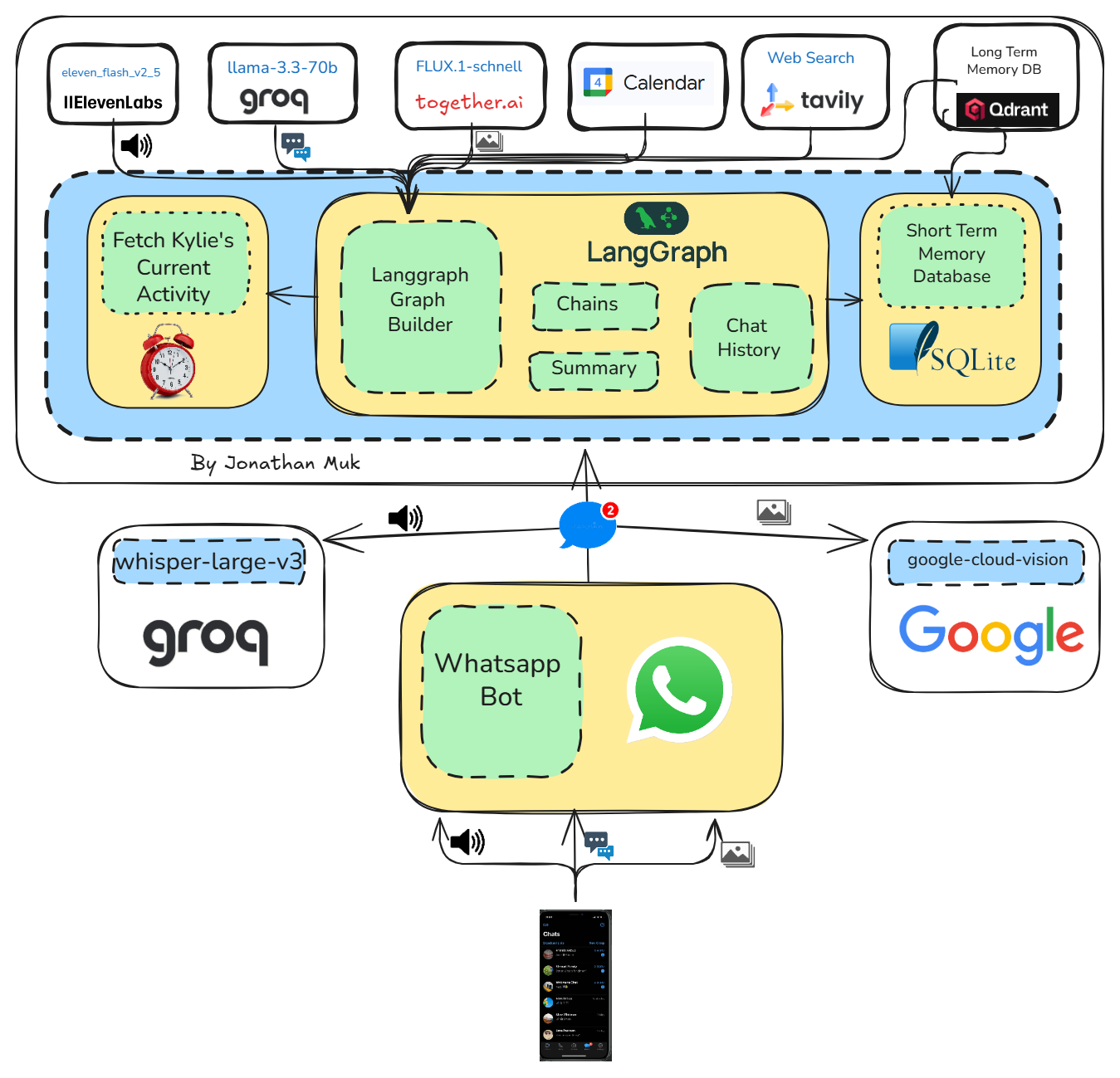
Kylie is a FastAPI service behind the WhatsApp Cloud API webhook, with a LangGraph workflow as the brain. Incoming audio is transcribed and incoming images are described before they reach the graph, so every modality becomes text by the time routing happens. On the way out the reply can become a synthesised voice note or a generated image. Conversations are stored as embeddings in Qdrant, which gives both session memory and recall across sessions.
Technical decisions
Decision 1: Where the agent lives
- Chose
- Inside WhatsApp through the Meta Cloud API
- Considered
- A web chat interface
- A Telegram bot
- Because
- Distribution was the point. Someone can try it from a contact card without installing anything, and the constraints of a real messaging channel are what make the build interesting.
Decision 2: Orchestration
- Chose
- LangGraph with explicit state and routing
- Considered
- A prompt chain
- A single model call with tools
- Because
- Five different reply types (conversation, image, audio, tools, search) need different work. A graph makes the routing decision explicit and inspectable rather than hidden in a prompt.
Decision 3: Long-term memory
- Chose
- Qdrant with all-MiniLM-L6-v2 embeddings
- Considered
- Stuffing the full history into the prompt
- A relational store with keyword lookup
- Because
- Recall needs to work by meaning, not by keyword, and the prompt budget is finite. Semantic retrieval returns the few facts that matter for this message instead of everything ever said.
Decision 4: Multimodality
- Chose
- Normalise everything to text at the edges
- Considered
- A multimodal model handling raw audio and images end to end
- Because
- One brain, one state shape. Transcribing and describing at the boundary means the graph never has to branch on modality, and each converter can be swapped independently.
Implementation
The pieces that carried over to the MCP edition, and the ones that did not:
Carried over
The LangGraph brain, the memory split, the multimodal edges, the Groq model choices and the character prompt all survived the rewrite more or less intact.
Replaced
The calendar tools, the web search client and the schedule lookup were hand-written and imported directly into the graph. In the MCP edition they live behind a protocol boundary instead.
What did not work
What did not work
The capabilities were welded in. Every tool was a hand-written wrapper with a hand-written schema, imported straight into the agent brain, so nothing could be reused outside Kylie: putting the same calendar ability into another assistant meant writing it again. Observability was worse. LangSmith showed the model calls, but the decisions around them, which route was picked and what a tool actually returned, still came down to reading print statements. Both problems are structural, not bugs, which is why the answer was a rebuild rather than a patch. That rebuild is the MCP edition.
Results
Kylie reached 110 or more GitHub stars and 34 forks, and Qdrant found the project through a LinkedIn post and featured it on X and LinkedIn as a practical, end-to-end example of an agent with vector memory. Those are the numbers I have; message volume and latency were never instrumented in this version, which is itself part of why the next one starts with tracing.
Results at a glance
110+
GitHub stars
Counted 18 September 2026
34
Forks
Counted 18 September 2026
7
External services integrated
Stack
- Core
- Python
- FastAPI
- LangGraph
- LangChain
- Observability
- LangSmith
- Memory
- Qdrant
- Intelligence
- Groq
- Services
- Google Cloud
- Tavily
- ElevenLabs
- Together AI
- Meta Developers









Recognition
A practical, end-to-end example of building production-ready AI agents with vector memory.